Lumail vs Elastic Email
Lumail
Elastic Email
Email marketing and delivery platform
Lumail and Elastic Email pricing and feature comparison
Free emails / month
Lumail
3,000
Elastic Email
3,000
Unlimited subscribers · $0
1,000 subscribers · $0
Paid entry
$20/month, 40,000 included, then $0.60/1,000
Email API from $19/month; Email Marketing from $29/month
Pricing basis
Unlimited subscribers; pricing follows email volume
Marketing plans scale with contacts and a send cap; the Email API scales with volume
Automation
Graph workflows with triggers, branches, goals, exits, and A/B paths
Visual automations on Email Marketing Pro
AI and developer access
ChatGPT OAuth, MCP, skills, CLI, SDK, REST API, and visual editor
Hosted MCP with a short list of actions, plus REST API
Transactional email
Included through API, SMTP, SDK, CLI, and agent tools
REST API and SMTP on Email API plans and paid Email Marketing plans
Publishing surface
Capture pages and custom web domains; not a general website builder
Landing pages, signup forms, and link in bio; paid newsletters on Pro
Choose Lumail if…
- You want unlimited subscribers billed only by email volume
- Agents should run campaigns, workflows, and transactional email through MCP, CLI, and SDK
- You want workflows on every plan, not only on Pro
Choose Elastic Email if…
- You need a sending API at $19/month for 50,000 emails
- You want contact-priced campaigns with landing pages and paid newsletters
- You are an agency that needs white-label sending and subaccounts
Where Elastic Email is strong
A real alternative, not a straw man.
Elastic Email runs its own sending infrastructure and sells two main products: Email Marketing, priced by contacts, and an Email API, priced by volume. People pick Elastic Email when they need cost-conscious small businesses and developers that want affordable campaigns plus API sending.
- Email API Starter sends 50,000 emails for $19/month
- Own sending infrastructure with REST API, SMTP, and libraries for 12 languages
- Pro adds paid newsletters, Stripe checkout, and reseller tools
Don't trust the table. Run one journey.
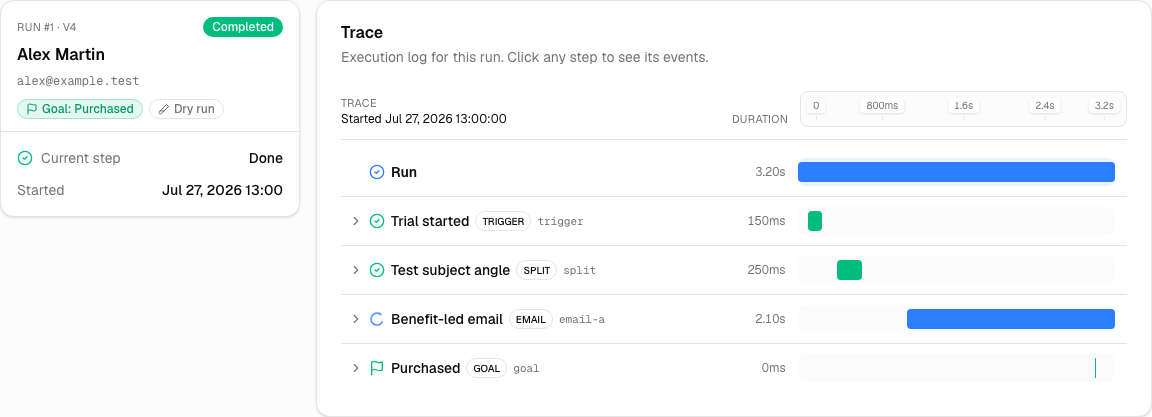
Checklists lie by flattening the work. Build one real path: a trigger, a wait, a branch, a goal, an exit. Then open one subscriber and see what actually happened. That tells you more than any feature row.
- 1. Import a small, consented sample. Not the whole list.
- 2. Recreate one campaign and the audience it actually hits.
- 3. Publish one automation with a goal you can measure.
- 4. Fire a test and read every event on one person.
- 5. Compare the weekly work, not the setup afternoon.
Try it on a real send
Keep the whole list. Pay when you send.
3,000 emails free, no card. Rebuild one campaign, one workflow, and one transactional message before you move anyone. If it feels worse than Elastic Email, stay.
The questions people actually ask
Is Lumail cheaper than Elastic Email?
Sometimes. Lumail is $0 for 3,000 emails, then $20 for 40,000. Elastic Email's number only makes sense after you know what they cap: contacts, seats, a daily send limit, or a feature they hide behind a paid plan. Read the honest take above, then price a normal month and a launch month on both pages.
What is the main difference between Lumail and Elastic Email?
Choose Elastic Email for low-cost SMTP and API sending or contact-priced campaigns with landing pages. Choose Lumail for unlimited subscribers, workflows on every plan, transactional email in the same place, and a full MCP, CLI, and SDK surface.
Can I migrate from Elastic Email to Lumail?
Yes. Don't move the whole list on day one. Export a small consented sample, rebuild one campaign and one automation, authenticate your domain, then watch one subscriber go through the run. If that feels right, move the rest.