Best Buttondown Alternatives in 2026: 6 Tools Compared
Compare the 6 best Buttondown alternatives for writers: Lumail, Kit, beehiiv, Ghost, Substack and EmailOctopus, by pricing model, automation and monetization.
In this guide
The best Buttondown alternatives are Lumail, Kit, beehiiv, Ghost, Substack and EmailOctopus, depending on whether you need automations without add-ons, creator monetization, a hosted publication, or simply a cheaper list. Buttondown is a good writing-first tool. Most people who leave it are not unhappy with the editor. They have outgrown the free tier, or they want a sequence and discover it is an extra line item.
We make Lumail, so it is listed first; every other entry is judged on the same criteria with facts from each vendor's pricing page as of August 2026.
Why people look for a Buttondown alternative
- The free plan ends at 100 subscribers. That covers a friends-and-family list. Past it, you pay a subscriber-based base price that rises as the list grows.
- Automation is an add-on. Buttondown sells automations as a $29/month add-on on top of the subscriber price, and other features start at $9/month each. A welcome sequence plus a couple of extras can cost more than the base plan.
- No transactional email. Buttondown is not positioned as a transactional email service, so a product that also sends receipts or login links needs a second provider.
- Monetization and growth tools are limited. Writers who want a recommendation network, an ad network, or a full publication website usually end up on a more publication-focused platform.
Buttondown alternatives at a glance
| Tool | Best for | Free plan | Paid from | Pricing basis |
|---|---|---|---|---|
| Lumail | Newsletters plus workflows and product email | 3,000 emails/month, no card | $20/month (40,000 emails) | Emails sent; unlimited subscribers |
| Kit | Creators selling products and paid tiers | Up to 10,000 subscribers | $33/month billed annually (1,000) | Subscriber tier |
| beehiiv | Publishers focused on growth and ads | 2,500 subscribers, unlimited sends | $43/month billed annually (Scale) | Plan and subscriber tier |
| Ghost | An owned publication website and paywall | 14-day trial; free to self-host | $15/month billed yearly (Starter) | Members and staff seats |
| Substack | The fastest hosted paid publication | Free for any subscriber count | 10% of paid revenue plus Stripe fees | Revenue share |
| EmailOctopus | Cheap, simple email-only newsletters | 2,500 subscribers, 10,000 emails/month | $9/month billed yearly (500) | Subscribers plus a send cap |
| Buttondown | Writing-first Markdown newsletters | First 100 subscribers | Subscriber-based; add-ons from $9 | Active subscribers plus add-ons |
1. Lumail: best for newsletters that need automations and product email
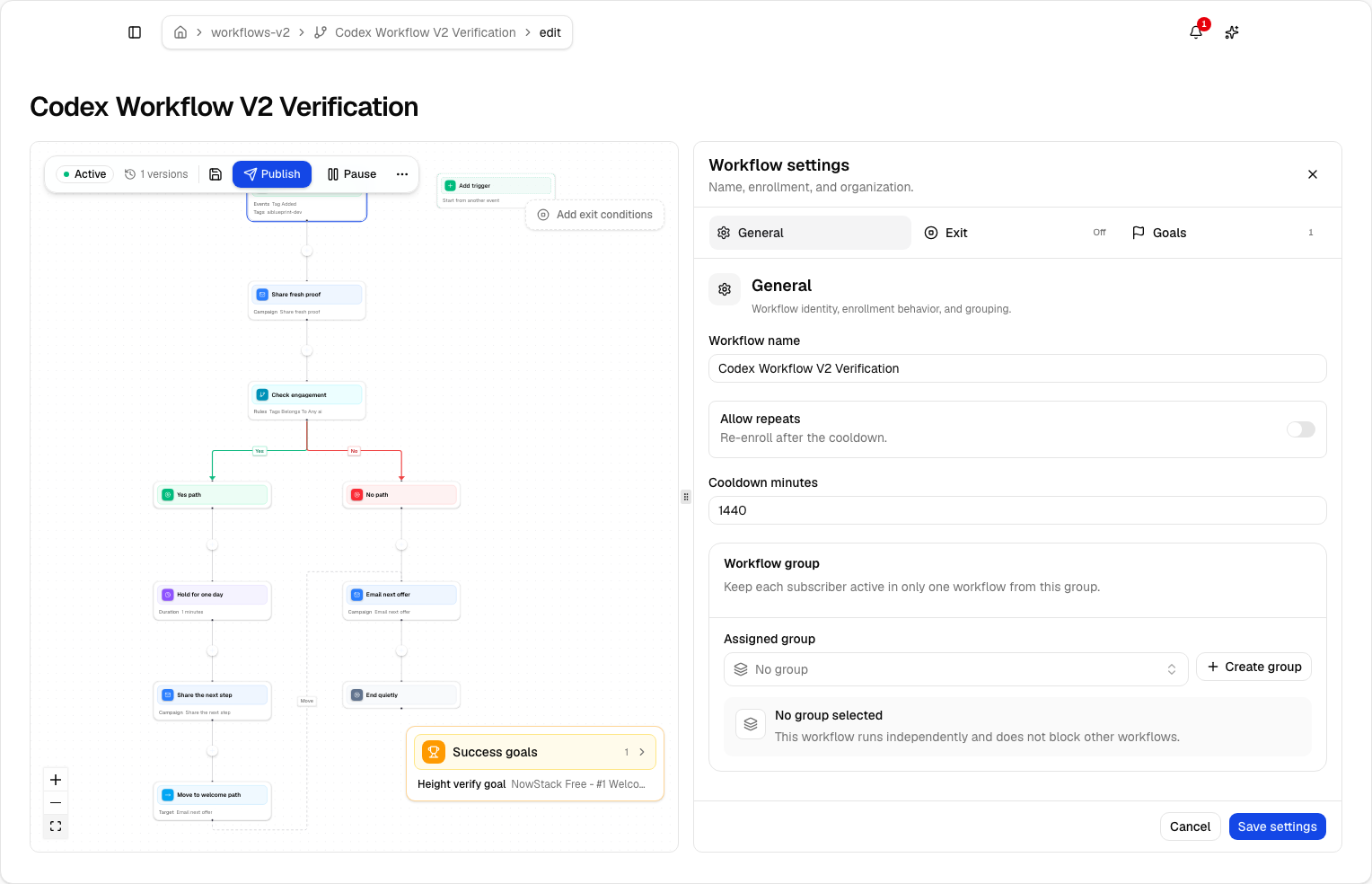
Lumail is an email platform built around campaigns, graph-based workflows and transactional email in one organization. You write in a visual editor, and the same account is reachable from 89 organization-scoped MCP tools in ChatGPT, Claude, Claude Code, Cursor and Codex, plus a CLI, TypeScript SDK and REST API. For a Buttondown writer, the practical difference is that a welcome sequence, a re-engagement branch and a password-reset email all live in the same place, with no add-ons to assemble.
Pricing: Free for 3,000 emails/month with no credit card. Premium is $20/month with 40,000 emails included, then $0.60 per 1,000. Business is $200/month with 400,000 emails, then $0.40 per 1,000. Subscribers are unlimited on every plan.
Choose it if:
- you want workflows (triggers, waits, conditions, branches, goals, A/B paths) without paying for an automation add-on;
- your list is large relative to how often you send;
- you want an AI assistant or your own code to run campaigns through MCP and the API.
Watch out for:
- Lumail has capture pages for growing your list, but no hosted newsletter archive and no paid subscriptions. If a public archive is central to your newsletter, keep that in mind.
See Lumail vs Buttondown side by side.
2. Kit: best for creators monetizing a newsletter
Kit is a creator newsletter platform with landing pages, a recommendation network, paid newsletters and digital products. Its free plan is generous for pure broadcasting: up to 10,000 subscribers with unlimited broadcasts.
Pricing: Free up to 10,000 subscribers. Creator starts at $33/month billed annually ($39 monthly) for 1,000 subscribers and rises with list size.
Choose it if:
- paid subscriptions and digital products are part of the business;
- you want Kit's recommendation network to grow the list;
- one automation is enough for now and you want to stay free.
Watch out for:
- the free plan includes one basic automation; a second sequence means moving to Creator, priced by list size;
- it is not positioned as a transactional email API.
See the full Lumail vs Kit comparison.
3. beehiiv: best for publishers chasing growth and ad revenue
beehiiv pairs the newsletter with a hosted publication website, recommendations, an ad network, paid subscriptions and newsletter-specific analytics. It suits writers who treat the newsletter as a media business.
Pricing: Free for 2,500 subscribers with unlimited sends. Scale starts at $43/month billed annually, and the tier grows with the subscriber count.
Choose it if:
- an ad network and recommendations are part of your growth plan;
- you publish often and want unlimited sends;
- a hosted website for the publication matters.
Watch out for:
- automations and write-capable MCP access start on Scale;
- the transactional Send API is reserved for Enterprise.
See the full Lumail vs beehiiv comparison.
4. Ghost: best for an owned publication website with memberships
Ghost is an open-source publishing CMS: website, themes, members, paywall and native newsletters in one product. You can self-host the MIT-licensed software or pay for managed Ghost(Pro). Ghost takes a 0% platform fee on paid memberships (Stripe processing still applies).
Pricing: No forever-free hosted plan, only a 14-day trial. Starter is $15/month billed yearly, capped at 1,000 members, and does not include paid subscriptions. Publisher starts at $29/month billed yearly.
Choose it if:
- you want a real website and paywall, with email as one publishing channel;
- you want to keep 100% of membership revenue apart from Stripe fees;
- you are comfortable self-hosting, or paying by member count.
Watch out for:
- automations are a Labs beta limited to two welcome flows;
- every signed-up member counts toward the plan, and exceeding the limit disables publishing until you upgrade.
See the full Lumail vs Ghost comparison.
5. Substack: best free path to a paid publication
Substack gives you hosting, email delivery, an app, community features and a reader network for free. It only earns money when you do: 10% of paid-subscription revenue.
Pricing: Free for any subscriber count. Paid subscriptions cost 10% of that revenue, plus Stripe fees.
Choose it if:
- you want the shortest setup time of any tool here;
- Substack's reader network is part of your growth plan;
- you prefer a revenue share over a monthly software bill.
Watch out for:
- the 10% share grows with your paid revenue, every month;
- there are no graph workflows, no transactional email and no organization-wide API or MCP.
See the full Lumail vs Substack comparison.
6. EmailOctopus: best low-cost, email-only newsletter tool
EmailOctopus is a straightforward email-only product: campaigns, tree-view automations, tags, forms and landing pages, without SMS or a larger suite. Its free plan is one of the more generous ones.
Pricing: Free Starter plan with 2,500 subscribers and 10,000 emails/month, no card. Pro starts at $9/month billed yearly ($10 monthly) for 500 subscribers.
Choose it if:
- you want cheap, simple campaigns and a basic drip;
- your list fits the 2,500-subscriber free plan;
- you do not need anything beyond email.
Watch out for:
- the hosted product has no API or SMTP sending, so it cannot send transactional email;
- there is no official MCP or CLI for AI agents.
See the full Lumail vs EmailOctopus comparison.
How to choose a Buttondown alternative
Most Buttondown alternatives differ less in the editor than in how they charge and where the newsletter lives.
- Match the pricing basis to your list. Buttondown, Kit, beehiiv, Ghost and EmailOctopus all charge more as the list grows. Lumail charges by emails sent. Substack charges a share of paid revenue.
- Decide where the newsletter lives. If you need a public archive or website, Ghost, beehiiv and Substack are built for it. Lumail and EmailOctopus are email tools, not publishing platforms.
- Count your sequences. One welcome email fits almost anywhere. Several branching sequences favor a tool that includes automations on every plan.
- Check whether your product sends email too. If you also send receipts or login links, only Lumail on this list sends marketing and transactional email from the same account on every plan.
- Consider AI and developer access. If an assistant or script will run the newsletter, compare MCP and API coverage, not just the AI writing button.
A worked example: 10,000 subscribers, weekly newsletter
Four sends a month to 10,000 subscribers is 40,000 emails.
| Tool | Monthly cost for this list |
|---|---|
| Lumail | $20 (Premium includes exactly 40,000 emails) |
| EmailOctopus | $44.50 (Pro, 10,000 subscribers and 100,000 emails) |
| Ghost | $88 billed yearly (Publisher, 10,000 members) |
| Kit | $139 (Creator, 10,000 subscribers) |
| beehiiv | Paid Scale tier for 10,000; check its pricing page |
| Buttondown | Check its pricing page for your tier, plus $29 automations |
On Lumail, a 2,000-email welcome sequence on top would add $1.20 in overage. The shape flips for a small list you email every day: a flat-price plan with unlimited sends can then come out ahead.
How to migrate from Buttondown
- Export subscribers and suppressions. Export active subscribers with tags and consent data, and export unsubscribes too. Import suppressions first so nobody who left gets mailed again.
- Authenticate your sending domain. Set up SPF and DKIM on the new platform and verify the domain. Keep Buttondown active while DNS propagates.
- Rebuild one automation. Recreate your welcome sequence and test it with a few addresses, including the unsubscribe path.
- Send one test campaign to a segment. Pick an engaged, consented segment and check rendering, links and the recipient count before you schedule the full list.
- Move the rest. Once opens and bounces look normal, send to everyone and cancel Buttondown's add-ons.
Frequently asked questions
What is the best free Buttondown alternative?
For a pure newsletter, Kit's free plan covers up to 10,000 subscribers with unlimited broadcasts and one automation. Substack is free for any list size if you accept a 10% share on paid revenue. Lumail's free plan gives 3,000 emails a month with unlimited subscribers and workflows included.
Is there a cheaper alternative to Buttondown?
It depends on list size and frequency. Buttondown is free under 100 subscribers. Past that, a large list you email a few times a month is usually cheaper on a send-based plan like Lumail Premium at $20 for 40,000 emails, especially once you would otherwise add the $29/month automation add-on.
How does Buttondown pricing work?
Buttondown charges by active subscribers, free for the first 100, then a subscriber-based base price. Optional features are add-ons from $9/month, and automation is a $29/month add-on. Check its pricing page for your exact tier.
What is the best Buttondown alternative for paid newsletters?
Substack is the fastest route, with a 10% revenue share. Ghost takes 0% platform fees but charges a hosting plan by member count. Kit and beehiiv also support paid subscriptions alongside growth tools.
What is the best Buttondown alternative for developers?
Lumail, because the same account is reachable from 89 MCP tools, a CLI, a TypeScript SDK, a REST API and SMTP, and it sends transactional email alongside the newsletter.
Pick the tool that fits your next year
Buttondown is still a good home for a small, writing-first newsletter. If you are weighing Buttondown alternatives because you are adding sequences, product email or AI-run operations, start Lumail free with 3,000 emails a month and no credit card, or compare every option in the comparison hub.