Lumail vs Keap: Which Email Platform Fits How You Work?
Keap is a small-business CRM from $299/month for 1,500 contacts. Lumail is an email platform billed by emails sent, with workflows and 89 MCP tools.
In this guide
Lumail is an email platform that bills by emails sent, with unlimited subscribers on every plan. Keap, formerly Infusionsoft, is a small-business CRM with email, SMS, pipelines, invoices, and payments, starting at $299/month for two users and 1,500 contacts plus a required implementation package.
The two products answer different questions. Keap asks how a service business follows up, closes, and gets paid. Lumail asks how a team, or its AI agents, operates email. Keap facts in this comparison come from its official pricing page as of August 2026. Verify current limits before purchasing, and see the side-by-side comparison table for the compact version.
Lumail vs Keap at a glance
| Decision | Lumail | Keap |
|---|---|---|
| Core focus | Campaigns, workflows, transactional email, and AI-agent operations | Small-business CRM with email, SMS, pipeline, and payments |
| Pricing basis | Email volume; unlimited subscribers on every plan | Contacts plus user seats, with required implementation |
| Free plan | 3,000 emails per month, no credit card | None; 14-day trial limited to 25 emails |
| Paid entry | Premium at $20/month with 40,000 emails | $299/month for two users and 1,500 contacts |
| AI and developer access | 89 MCP tools, CLI, TypeScript SDK, REST API | In-app AI writing assistants and a REST API; no MCP |
| Automation | Graph workflows included on every plan | Easy and advanced builders with a large template library |
| Transactional email | Built in through the API or SMTP | No dedicated transactional service or SMTP relay |
| Best fit | Teams operating email through agents, code, and a visual app | Service businesses wanting CRM, follow-up, and payments together |
Lumail's current plans are on the Lumail pricing page.
Choose Lumail if AI agents should operate your email
This is the structural difference, and it matters more than any single feature row.
Keap offers in-app AI assistants that draft emails and fill automation templates with your copy, plus a REST API, webhooks, Zapier, and Node and PHP libraries. It documents no official MCP server, ChatGPT app, CLI, or TypeScript SDK. Its AI helps the person in the app; it does not let an assistant operate the account.
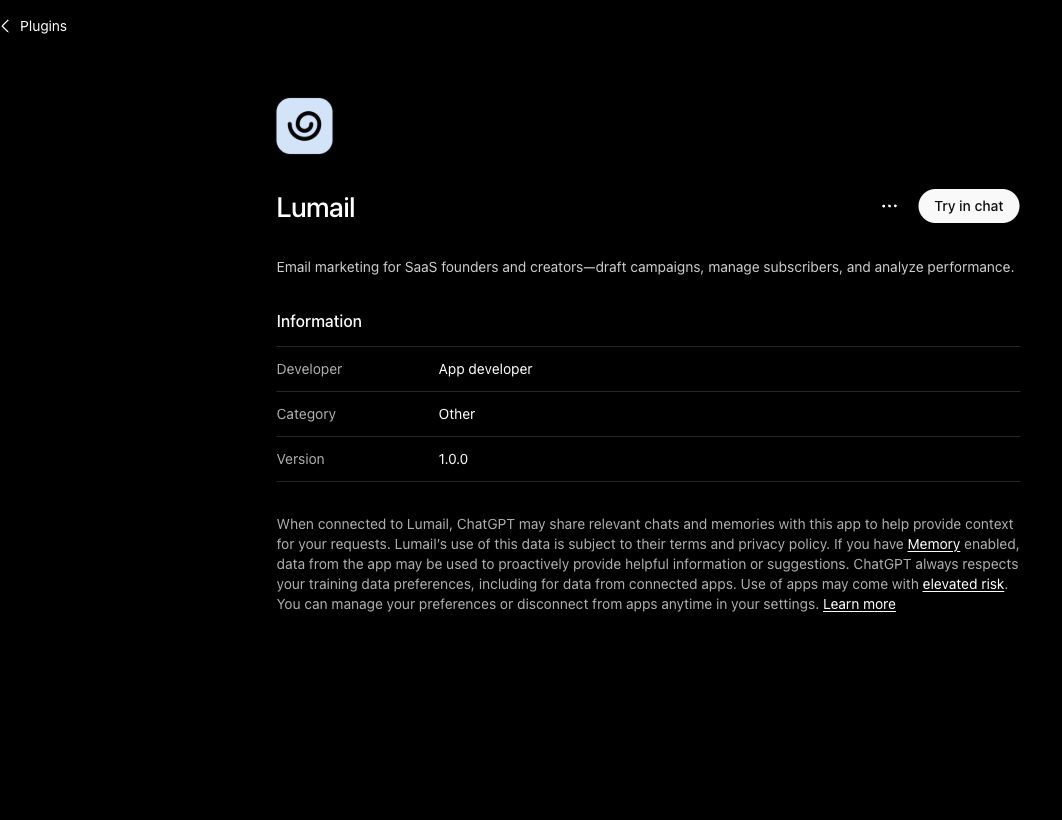
Lumail exposes 89 organization-scoped MCP tools covering subscribers, tags, segments, campaigns, workflows, templates, analytics, and transactional sending. The same operations run inside ChatGPT, Claude, Claude Code, and Cursor, plus a CLI, a TypeScript SDK, and a REST API.
In practice, you can ask an assistant to:
- draft next week's campaign from a brief and your existing template;
- build a segment from tags and engagement before a targeted send;
- read a workflow and explain why a subscriber took a specific branch;
- summarize last month's results without exporting a spreadsheet.
You keep consequential actions behind human approval. The point is removing the operational clicking, not the judgment.
Choose Keap if you need a CRM that gets you paid
Keap's strength is that follow-up, sales, and billing live in one place. Contacts, tags, and a sales pipeline sit next to appointment scheduling, quotes, invoices, checkout, and payments. SMS broadcasts and a business phone line are available alongside email in the US. Its automation library covers common small-business jobs, from lead magnets and cart abandonment to review requests and billing reminders.
Keap also sells help. Implementation is required, and it includes migration, a customer success manager, and strategy calls, so an owner who does not want to build automations gets them built.
Choose Keap if:
- you need CRM, pipeline, appointments, invoices, and payments next to email;
- you want SMS and a business phone line in the same account;
- you want Keap's team to migrate and launch your automations for you.
Lumail does not try to be a CRM or a payments tool. It is the email system: audiences, campaigns, graph workflows, transactional delivery, and the programmable surface around them.
Compare the pricing models, not the starting prices
Keap sells one platform priced by contacts and users. The entry price is $299/month, or $249/month billed annually, for two users and 1,500 contacts. Extra users cost $39/month, and extra contacts are added in steps as the list grows. Implementation is a required one-time fee on top, and SMS is sold in separate tiers. There is no free plan, only a 14-day trial capped at 25 emails.
Lumail prices by emails sent, with unlimited subscriber storage on every plan:
- Free: 3,000 emails per month, no credit card;
- Premium: $20/month with 40,000 emails included, then $0.60 per 1,000;
- Business: $200/month with 400,000 emails included, then $0.40 per 1,000.
A worked example
Say you run a service business with 1,500 contacts. You send two newsletters a month plus follow-up and reminder sequences, about 4,000 emails in total.
On Keap, that fits the entry plan: $299/month for two users, plus the one-time implementation fee. It also includes the CRM, pipeline, invoicing, and payments.
On Lumail, 4,000 emails is just past the free tier, so Premium: $20/month. If the list grows to 5,000 contacts and you keep the same rhythm, around 13,000 emails, it is still $20. On Keap, the extra 3,500 contacts move you up the contact steps.
If you would use Keap's CRM and payments every day, the $299 buys more than email. If you only need the email part, you are paying for a CRM you do not use.
Compare automation and transactional email
Keap offers Easy Automations for preset follow-ups, such as appointment reminders and purchase follow-up, and an Advanced builder for custom sequences. Pipeline stages can trigger the next step, and its AI assistant can fill a template with your business's copy. The automation is strong for sales follow-up; it is not designed for agents to read or edit.
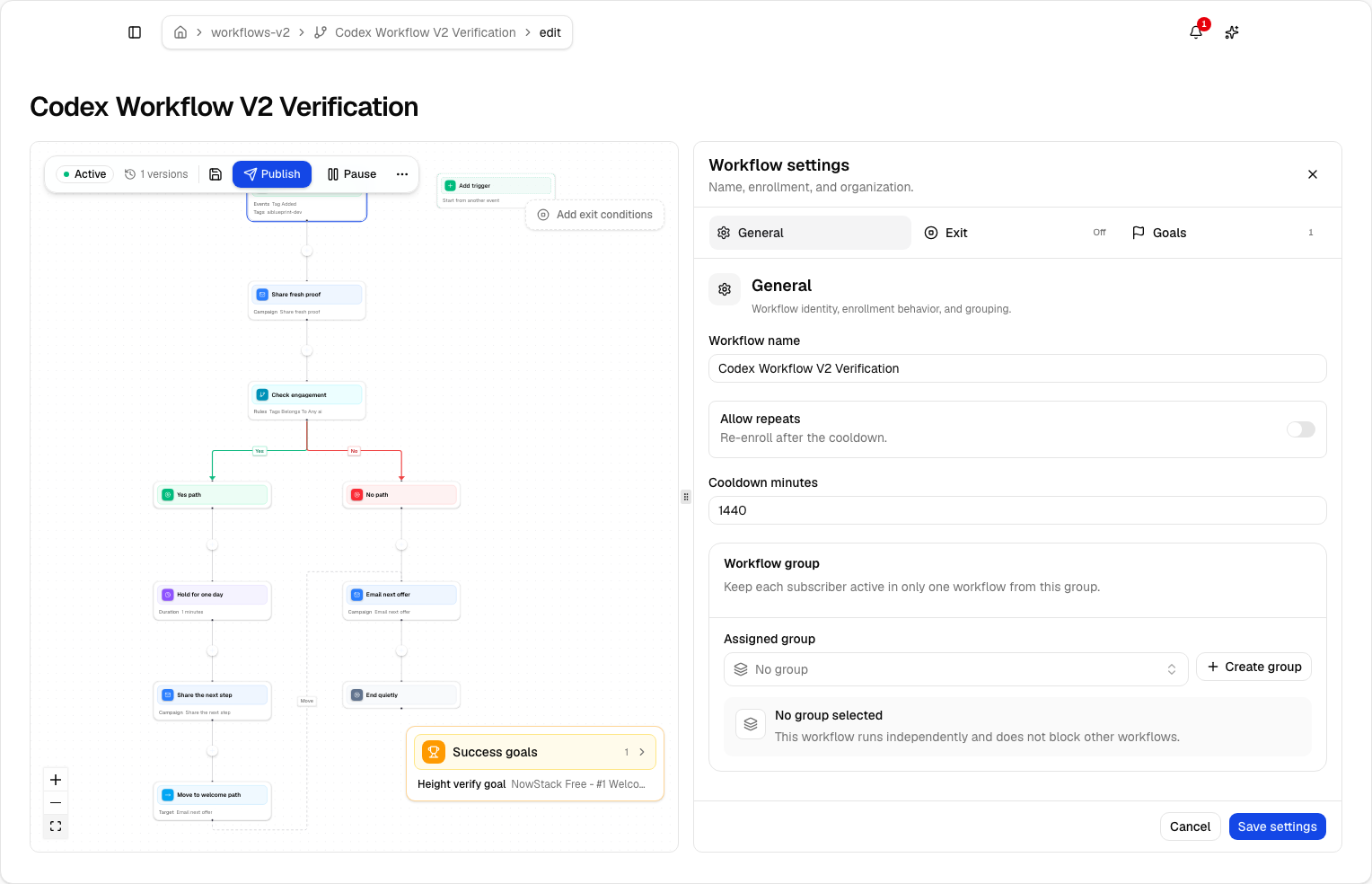
Lumail includes graph workflows on every plan: subscriber, tag, event, schedule, and manual triggers; email, wait, and webhook steps; condition branches; and goals and exit rules. Agents can read and edit the same workflows through MCP.
Keap does not sell a transactional email service or an SMTP relay. Its email is broadcasts, automation mail, and one-to-one messages synced from Gmail or Outlook. Lumail sends receipts, password resets, and other product email through the REST API or smtp.lumail.io:587 with STARTTLS, in the same organization as your campaigns.
Migrating from Keap to Lumail
- Decide what stays. Pipeline, invoices, appointments, payments, and SMS do not move. If you still need them, keep Keap as the CRM and move email only.
- Export contacts, tags, and suppressions. Confirm consent before import, and bring unsubscribes along with active contacts.
- Authenticate your sending domain. Set up SPF and DKIM in Lumail and keep Keap sending while DNS propagates.
- Rebuild your key sequence. Recreate your most valuable automation, such as a lead magnet or nurture sequence, as a graph workflow and test every branch.
- Send one campaign and connect agents. Send to a small segment first, then connect MCP to your assistant and run one real task.
Frequently asked questions
Is Lumail a Keap alternative?
Yes for email campaigns and automations, not as a full CRM swap. Keep Keap if you still need its pipeline, SMS, invoices, and payments.
Is Lumail cheaper than Keap?
Usually for email-only teams: Keap starts at $299/month plus a required implementation fee, while Lumail Premium is $20/month. Keap can still be the better value if you would otherwise buy a CRM, SMS, and invoicing separately.
What is the main difference between Lumail and Keap?
Keap is a CRM-centered small-business platform billed by contacts and seats. Lumail is an email platform billed by volume, with graph workflows, transactional email, and 89 MCP tools so agents can operate the system.
Can I migrate from Keap to Lumail?
Yes. Export contacts, tags, and suppressions, import them into Lumail, and rebuild your sequences as graph workflows; there is no one-click importer.
Which one should you choose?
Choose Keap if you run a service business that needs CRM, pipeline, SMS, invoicing, and payments in one account, and you want Keap's team to set it up with you.
Choose Lumail if email is a system you operate: agents working through 89 MCP tools, graph workflows and transactional email on every plan, and a bill that follows what you send instead of contacts and seats.
You can start Lumail free with 3,000 emails per month and no credit card, review the pricing plans, or browse the full comparison hub.