Lumail vs SendGrid: Which Email Platform Fits How You Work?
SendGrid sells its email API and marketing campaigns as two products. Lumail puts newsletters, workflows, and transactional email in one plan.
In this guide
Twilio SendGrid is a high-volume email delivery platform sold as two separate products: an Email API for sending from code, and Marketing Campaigns for lists, newsletters, and drip series. Lumail is one email platform: newsletters, subscribers, graph workflows, and transactional email in one organization and one bill, which AI agents can operate.
If you only need transactional sending at scale, SendGrid is a proven choice. The comparison gets interesting when you need both app email and marketing email, because on SendGrid that means two subscriptions with separate quotas. SendGrid facts in this comparison come from Twilio's official pricing page as of August 2026. For the compact version, see the side-by-side comparison table.
Lumail vs SendGrid at a glance
| Decision | Lumail | SendGrid |
|---|---|---|
| Core focus | Newsletters, workflows, transactional email, AI agents | High-volume email API, plus a separate marketing product |
| Pricing basis | Emails sent; unlimited subscribers on every plan | Two subscriptions: API by volume, marketing by contacts and volume |
| Free plan | 3,000 emails per month, no credit card | 60-day trial at 100 emails per day |
| Paid entry | Premium at $20/month with 40,000 emails included | Marketing from $15/month; Email API from $19.95/month |
| AI and developer access | 89 MCP tools, ChatGPT app, CLI, TypeScript SDK, REST API | REST API, SMTP, SDKs; MCP only searches documentation |
| Automation | Graph workflows on every plan, including Free | Drip series on Marketing Campaigns Advanced, from $60/month |
| Transactional email | Same organization and plan, through the API or SMTP | The core Email API product, billed separately from marketing |
| Best fit | Teams that want one email platform agents can run | Engineering teams sending at very high volume, often on Twilio |
Lumail's current plans are on the Lumail pricing page.
Choose Lumail if AI agents should operate your email
SendGrid offers a REST API, SMTP relay, and official SDKs for seven languages. Twilio's MCP server is in public beta and only searches Twilio and SendGrid documentation; it does not send email or change your account. Twilio also publishes skills that teach coding agents how to call the Email API. There is no ChatGPT app or MCP catalog that operates a SendGrid workspace.
Lumail exposes 89 organization-scoped MCP tools covering campaigns, subscribers, tags, segments, workflows, templates, analytics, and transactional sending. They work in ChatGPT, Claude, Claude Code, and Cursor, alongside a CLI, a TypeScript SDK, and a REST API. Every tool is scoped to your organization, so an agent acts on your real audience and real campaign state.
In practice, you can ask an assistant to:
- draft next week's newsletter from a brief and your existing template;
- build a segment of trial users who never opened the onboarding email;
- add a branch to a workflow and explain what it changes;
- send a transactional test and check its delivery;
- summarize the last quarter of campaign results.
Sending and scheduling stay behind human approval. The difference is that an agent can do the work, not just look up how the API works.
Choose SendGrid if you need delivery at Twilio scale
SendGrid is built for volume. Twilio says it delivers more than 205 billion emails a month, and the Email API comes with dynamic templates, event webhooks, inbound email parsing, and subusers for separating teams or clients.
It also covers infrastructure Lumail does not. SendGrid's Email API Pro plan, from $89.95/month, includes a dedicated IP, with more available to buy, plus IP warmup and single sign-on. It parses inbound email and posts it to your application. Lumail has no inbound email routing and does not sell dedicated IPs.
Choose SendGrid if:
- transactional volume and inbox placement at large scale are the product you are buying;
- you need dedicated IPs, IP pools, subusers, or inbound email parsing;
- you already use Twilio for SMS, WhatsApp, or voice and want email on the same bill.
Compare the pricing models, not the starting prices
SendGrid's pricing is really two price lists. The Email API is billed by sending volume: Essentials from $19.95/month and Pro from $89.95/month. Marketing Campaigns is billed by stored contacts plus marketing email volume: Basic from $15/month and Advanced from $60/month. You buy them separately, and sends on one do not count against the other. New accounts get a 60-day trial at 100 emails a day. After it ends, sending stops until you pick a paid plan.
Lumail prices on emails sent, with unlimited subscriber storage on every plan, and transactional and marketing email share the same allowance:
- Free: 3,000 emails per month, no credit card;
- Premium: $20/month with 40,000 emails included, then $0.60 per 1,000;
- Business: $200/month with 400,000 emails included, then $0.40 per 1,000.
A worked example
Say you run a SaaS product that sends 20,000 transactional emails a month and a newsletter twice a month to 8,000 contacts, with a welcome sequence for new signups. That is about 36,000 emails.
On SendGrid, the transactional email fits Email API Essentials from $19.95. The newsletter needs Marketing Campaigns, and the welcome sequence needs Advanced, from $60. That is at least $79.95 a month across two subscriptions.
On Lumail Premium, all 36,000 emails fall inside the 40,000 included, so the month costs $20, with workflows and unlimited subscribers included.
If you only need transactional sending, the picture changes: Email API Essentials at $19.95 is close to Lumail's $20. SendGrid gets expensive when you need both halves.
Compare automation and transactional email
SendGrid's automation lives in Marketing Campaigns Advanced, from $60/month. It is a drip series: contacts enter when they join a list or segment, and emails go out after set delays in days or hours. SendGrid's own documentation suggests keeping a series to about 10 emails. There are no branches or event triggers, and Basic does not include automation at all.
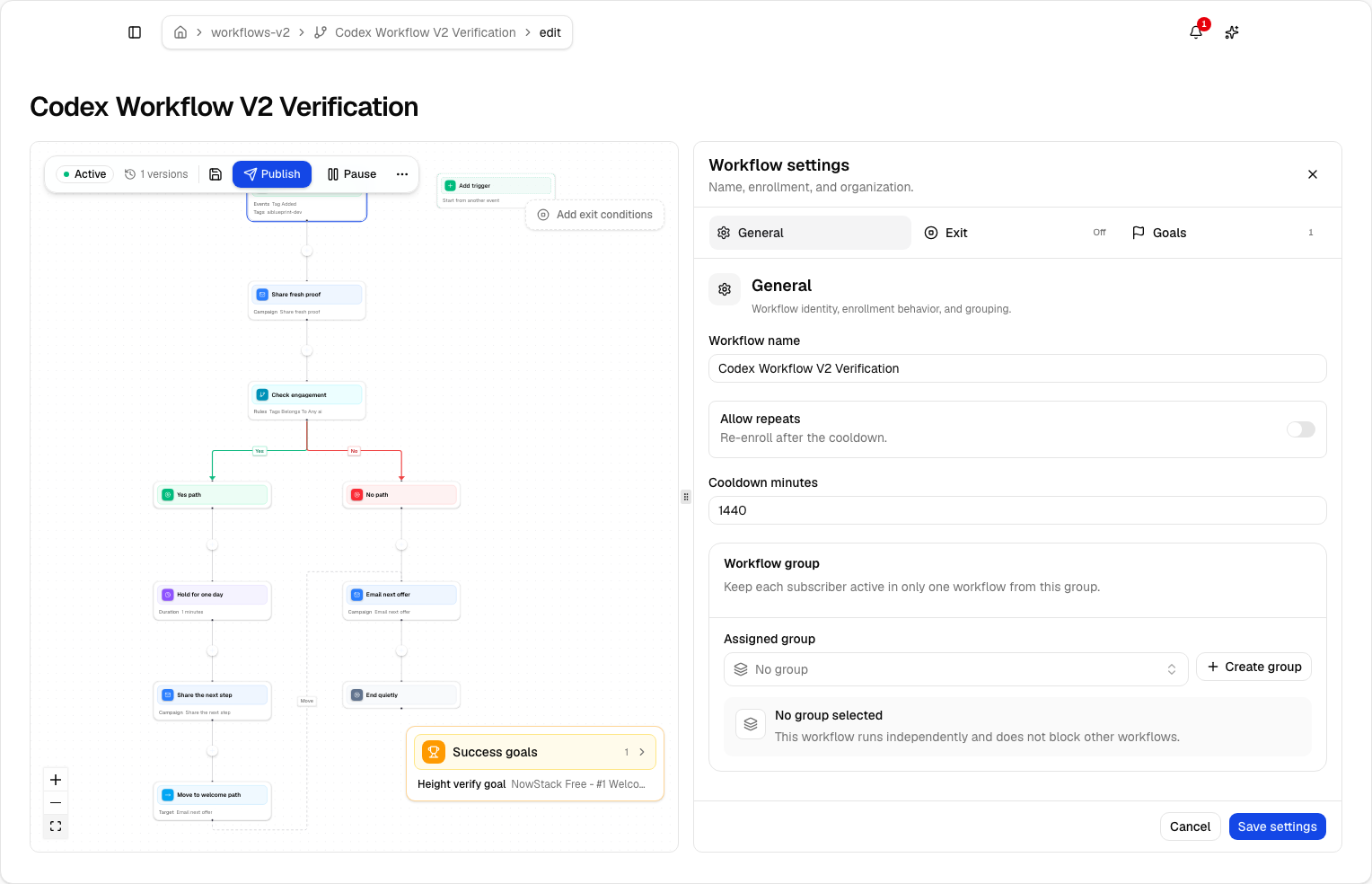
Lumail's workflow engine is graph-based and included on every plan: subscriber, tag, event, schedule, and manual triggers; email, wait, action, and webhook steps; condition and weighted branches; goals and exit rules. The same workflows are readable from the app, MCP tools, CLI, SDK, and API.
Transactional email is SendGrid's core product, and it is billed only against the Email API plan. Lumail sends transactional email through its REST API or SMTP relay at smtp.lumail.io:587 with STARTTLS, from the same organization and allowance as your newsletters. One domain setup, one subscriber database, one bill.
Migrating from SendGrid to Lumail
On SendGrid, marketing and transactional email are separate streams, so plan for both.
- Export contacts and suppressions. Export Marketing Campaigns contacts along with unsubscribes and bounces. Suppressions protect your sender reputation after the move.
- Authenticate your sending domain. Set up SPF and DKIM in Lumail and verify the domain. Keep SendGrid live while DNS propagates.
- Rebuild your drip series as a workflow. Recreate each list-based series as a graph, then add the branches the drip could not express. Test with a few subscribers.
- Move transactional sending, or not. Point app email at Lumail's API or SMTP, or keep SendGrid's Email API for app email and move only marketing.
- Send one campaign and connect your agents. Send to a consented segment, check rendering and links, then run one real task through MCP.
Frequently asked questions
Is Lumail a SendGrid alternative?
Yes, if you want campaigns, graph workflows, subscribers, and transactional email in one organization agents can operate. For very high-volume transactional sending with dedicated IPs, SendGrid is the better fit.
Is Lumail cheaper than SendGrid?
It depends on which SendGrid products you need. For pure API volume, Email API Essentials at $19.95 is close to Lumail's $20. If you also need newsletters and automation, SendGrid adds Marketing Campaigns Advanced from $60, while Lumail stays one plan.
What is the main difference between Lumail and SendGrid?
SendGrid is delivery infrastructure split into two products with separate bills. Lumail is one email platform with graph workflows on every plan and 89 MCP tools that operate your account.
Can I migrate from SendGrid to Lumail?
Yes. Export contacts and suppressions, authenticate your domain, rebuild drip series as workflows, and point sends at Lumail. If you use both SendGrid products, migrate both streams.
Which one should you choose?
Choose SendGrid if you send transactional email at very large scale, need dedicated IPs and subusers, or already buy other Twilio channels.
Choose Lumail if you want marketing and transactional email in one place: one plan, graph workflows on every tier, unlimited subscribers, and 89 MCP tools your agents can use today.
You can start Lumail free with 3,000 emails per month and no credit card, review the pricing plans, or browse the full comparison hub.