Best Plunk Alternatives in 2026: 6 Tools Compared
Compare the best Plunk alternatives: included-volume plans that beat $0.001 per email past 20,000 sends, AI-agent access, and pure transactional APIs.
In this guide
The best Plunk alternatives are Lumail, Resend, Loops, Amazon SES, Postmark, and MailerSend, depending on whether you want included volume instead of pure pay-as-you-go, AI agents operating your email, a SaaS lifecycle tool, or a dedicated transactional API. Plunk is a good open-source product, and for small senders its pricing is hard to beat. The reasons to leave usually show up as volume grows or as your team wants more than a developer dashboard.
We make Lumail, so it is listed first; every other entry is judged on the same criteria with facts from each vendor's pricing page as of August 2026.
Why people look for a Plunk alternative
- Pay-as-you-go stops being cheap at volume. Hosted Plunk charges $0.001 per email with no base fee and no included bucket, so 40,000 emails cost $40 and 400,000 cost $400. Plans with included volume overtake it past a certain point.
- The free plan is small and branded. Hosted free is 1,000 emails/month, and marketing emails carry a Plunk-branded footer.
- No first-party agent tooling. Plunk's docs list no official MCP server, ChatGPT plugin, or CLI. The official Node helper covers tracking and sending only.
- Self-hosting is real work. The free self-hosted path means running Docker Compose and your own AWS SES account, which is great for some teams and a chore for others.
Plunk alternatives at a glance
| Tool | Best for | Free plan | Paid from | Pricing basis |
|---|---|---|---|---|
| Lumail | Agent-operated email with included volume | 3,000 emails/month, no card | $20/month (40,000 emails) | Emails sent; unlimited subscribers |
| Resend | Developer-first transactional with SDKs | 3,000 transactional or 1,000 marketing contacts | $20 transactional; $40 marketing | Separate transactional and contact plans |
| Loops | SaaS lifecycle email with unlimited sends | 1,000 contacts, 4,000 sends/month | $49/month (1,000–5,000 contacts) | Contact tier; unlimited sends on paid plans |
| Amazon SES | Raw sending you control, at the lowest rate | No standing free allotment; AWS credits | $0.10 per 1,000 emails | Per email, pay as you go |
| Postmark | Stream-separated transactional deliverability | 100 emails/month | $15/month (10,000 emails) | Monthly email volume |
| MailerSend | Transactional templates, SMS, and a hosted MCP | 500 emails/month, card required | $7/month (5,000 emails) | Monthly email volume |
| Plunk | Open-source, self-hostable email platform | 1,000 emails/month (hosted) | $0.001 per email, no base fee | Per email; unlimited contacts |
1. Lumail: best for agent-operated email with included volume
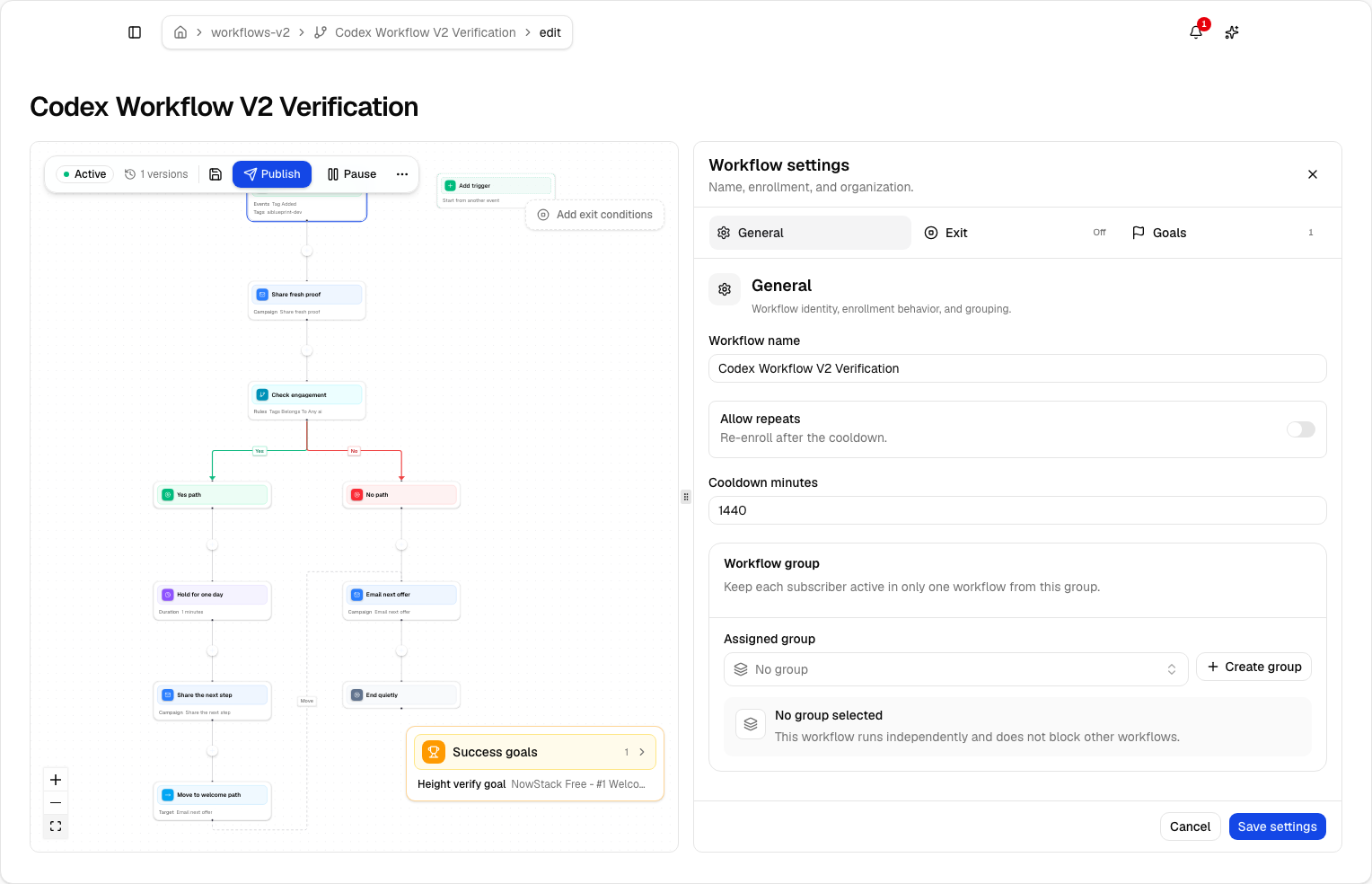
Lumail covers the same ground as Plunk (transactional email, campaigns, and graph workflows in one place) and adds two things Plunk does not have: a first-party agent surface and capture pages. Agents can manage subscribers, campaigns, workflows, and transactional sends through 89 organization-scoped MCP tools in ChatGPT, Claude, Claude Code, Cursor, and Codex, alongside a CLI, TypeScript SDK, and REST API. Workflows are graphs with triggers, waits, conditions, branches, goals, exit rules, A/B paths, and webhooks on every plan. Transactional mail goes through the API or smtp.lumail.io:587 with STARTTLS.
Pricing: Free is 3,000 emails/month with no credit card. Premium is $20/month with 40,000 emails included, then $0.60 per 1,000. Business is $200/month with 400,000 included, then $0.40 per 1,000. Subscribers are unlimited on every plan, like Plunk's contacts.
Choose it if:
- You send more than 20,000 emails a month, where Premium's included 40,000 costs less than $0.001 per email
- You want an AI agent to operate the whole platform, not only send
- You need capture pages to grow the list
Watch out for:
- Lumail is closed-source SaaS; there is no self-hosted option
- It has no inbound email product, which Plunk offers
See Lumail vs Plunk side by side.
2. Resend: best for developer-first transactional sending
Resend is developer email infrastructure: transactional sending over REST API and SMTP, inbound email, broadcasts, contacts, automations, webhooks, and deliverability tooling. Its SDK ecosystem, including React Email, is the main reason developers pick it. Plunk publishes its own comparison page against it.
Pricing: Free is 3,000 transactional emails or 1,000 marketing contacts. Paid starts at $20/month for transactional and $40/month for marketing. Paid plans include 10,000 automation runs, with usage overage after that.
Choose it if:
- Transactional infrastructure is the main thing you are buying
- Resend's SDKs and React Email fit your stack
- You prefer separate budgets for transactional and marketing email
Watch out for:
- Transactional and marketing are separate plans, which Plunk's single usage pool avoids
- The marketing plan is priced by contacts, unlike Plunk's unlimited contacts
See the full Lumail vs Resend comparison.
3. Loops: best for SaaS lifecycle email with unlimited sends
Loops is a focused lifecycle email product for SaaS teams. It combines marketing broadcasts, event-driven loops, transactional email, and contact properties in an interface built around your product's users. It flips Plunk's model: instead of paying per email, you pay for a contact tier and send as much as you like.
Pricing: Free is 1,000 contacts and 4,000 sends/month. Paid starts at $49/month for 1,000–5,000 subscribed contacts, with unlimited sends on paid plans.
Choose it if:
- You email a small, known user base very frequently
- SaaS lifecycle email is your main use case
- You want a polished product-email interface instead of a developer dashboard
Watch out for:
- Price follows subscribed contacts, so a large list you rarely email gets expensive
- Paid starts at $49/month, a big step from Plunk's no-base-fee billing
See the full Lumail vs Loops comparison.
4. Amazon SES: best for raw sending you control
Self-hosted Plunk sends through Amazon SES, so SES itself is the natural alternative if what you really wanted was cheap sending. It is AWS's pay-as-you-go API and SMTP relay for transactional, marketing, and inbound mail, with no hosted editor or audience on top.
Pricing: À la carte outbound is $0.10 per 1,000 emails with no monthly minimum. New accounts default to Essentials (from $0.16 per 1,000) unless switched. There is no standing SES-only free allotment; new AWS customers can get up to $200 in Free Tier credits.
Choose it if:
- Raw cost matters more than any dashboard
- You already run on AWS and write email logic in your application
- You need dedicated IPs, inbound processing, or archiving
Watch out for:
- No campaign editor, lists UI, or workflow builder
- New accounts start in a sandbox limited to 200 messages per 24 hours to verified recipients
See the full Lumail vs Amazon SES comparison.
5. Postmark: best for stream-separated transactional deliverability
Postmark is a transactional email service for app email over REST API and SMTP. Transactional and broadcast traffic run on separate Message Streams so one never affects the other's reputation. It has an official local MCP server with 24 tools, a CLI, and inbound parsing to JSON on Pro and Platform.
Pricing: The free Developer plan is 100 emails/month. Basic is $15/month for 10,000 emails, then $1.80 per 1,000; Pro is $16.50 and Platform is $18 with lower overage rates.
Choose it if:
- Password resets and receipts must land, and that is the whole job
- You keep lists and sequences in your own application
- You want first-party AI tooling for sending operations
Watch out for:
- No journey builder, list uploads, or campaign reporting
- There is no paid tier between 100 and 10,000 emails a month
See the full Lumail vs Postmark comparison.
6. MailerSend: best for transactional templates, SMS, and a hosted MCP
MailerSend is MailerLite's transactional product: REST API, SMTP relay, drag-and-drop and HTML template builders, inbound routing, and US/Canada SMS on Starter and above. Its hosted MCP server names 127 tools for sending, domains, templates, suppressions, and SMS, and it ships a CLI.
Pricing: Free is 500 emails/month after approval, with a credit card required but not charged. Hobby is $7/month for 5,000 emails, then $1.50 per 1,000. Starter starts at $35/month for 50,000.
Choose it if:
- Non-developers need to edit transactional templates visually
- You want a hosted MCP for transactional operations
- You need transactional SMS in the US or Canada
Watch out for:
- Newsletters and marketing automation live in MailerLite, a separate product
- No visual workflow builder, which Plunk includes on every plan
See the full Lumail vs MailerSend comparison.
How to choose a Plunk alternative
- Find your break-even volume. Plunk's $0.001 per email is a straight line. Compare it with included-volume plans at your normal month and your biggest month.
- Decide if open source is a requirement. If you must self-host or inspect the code, most hosted alternatives are out. If not, weigh the time you spend running SES and Docker.
- Keep transactional and marketing together, or split them. Plunk puts both in one pool. Lumail and Loops do too; Resend splits them into two plans; Postmark, SES, and MailerSend are transactional-first.
- Check how agents will reach it. Lumail exposes the whole platform through MCP. MailerSend and Postmark offer MCP for sending operations. Plunk has no official MCP, and the SES MCP server is an AWS sample not recommended for production.
- Plan workflow migration. There is no official importer for Plunk's graph workflows, so budget time to rebuild them.
Worked example: where Plunk's pay-as-you-go crosses Lumail's plans.
| Emails per month | Plunk hosted ($0.001 each) | Lumail |
|---|---|---|
| 5,000 | $5 | $20 (Premium; Free covers 3,000) |
| 20,000 | $20 | $20 (Premium) |
| 40,000 | $40 | $20 (Premium) |
| 100,000 | $100 | $56 (Premium + 60,000 at $0.60/1k) |
| 400,000 | $400 | $200 (Business) |
Below 20,000 emails a month, Plunk hosted is cheaper or equal. Above it, included volume wins. For Loops, Postmark, and MailerSend at your exact volume, check each pricing page for your tier.
How to migrate from Plunk
- Export contacts and suppressions from the dashboard. Include unsubscribed and bounced contacts so they stay excluded after the move.
- Authenticate your domain with the new provider. Add SPF and DKIM records and keep Plunk sending until they verify.
- Re-point transactional calls. Replace Plunk's
/v1/sendcalls or SMTP settings with the new API or SMTP relay (Lumail's is documented in the SMTP guide), then test each template. - Rebuild one workflow first. Recreate your most important graph, such as onboarding, and run a test contact through every branch before rebuilding the rest.
- Send one campaign to a small segment, then move everything. Verify rendering, links, and unsubscribe handling before switching the full list.
Frequently asked questions
What are the best useplunk alternatives?
Lumail is the closest match for teams that want transactional email, campaigns, and graph workflows in one place, plus AI-agent access and included volume. Resend, Postmark, and MailerSend are stronger picks for transactional-only sending, Loops fits SaaS lifecycle email, and Amazon SES fits teams that want the raw pipe.
How much does Plunk cost?
Hosted Plunk is free for 1,000 emails/month with a Plunk footer on marketing emails, then $0.001 per email with no base fee and optional monthly spend caps. Self-hosting has no Plunk per-email fee; you pay your own infrastructure and AWS SES.
Plunk vs Resend: which should I use?
Plunk is open source, bills every email from one usage pool at $0.001, and keeps contacts unlimited. Resend splits email into a transactional plan from $20/month and a marketing plan from $40/month priced by contacts, and it is the stronger choice if its SDKs and React Email fit your stack.
Is there a Plunk alternative that works with AI agents?
Yes. Lumail exposes 89 organization-scoped MCP tools that work in ChatGPT, Claude, Claude Code, Cursor, and Codex, covering subscribers, campaigns, workflows, and transactional email. MailerSend and Postmark offer MCP servers focused on transactional sending.
Is Plunk cheaper than Lumail?
Below 20,000 emails a month, Plunk hosted is cheaper or the same, since 20,000 emails cost $20 on both. Above that, Lumail Premium's 40,000 included emails for $20 costs less, and at 400,000 emails Lumail Business is $200 versus $400 on Plunk.
Choose on volume and operating model
If you want open source and send modest volume, Plunk remains a sensible choice, and none of these Plunk alternatives will beat it on that. If your sending has outgrown pay-as-you-go or you want agents running your email, start Lumail free with 3,000 emails per month and no credit card, and compare other options in the email platform comparison hub.