Best Postmark Alternatives in 2026: 7 Tools Compared
Postmark alternatives for transactional email, compared on free tiers, cost at 25,000 emails, inbound parsing, and which add newsletters and workflows.
In this guide
The best Postmark alternatives are Lumail, Resend, Mailgun, SparkPost, MailerSend, Amazon SES, and Plunk, depending on whether you want a bigger free tier, a lower bill between 10,000 and 100,000 emails, a self-hostable option, or newsletters and lifecycle email next to your receipts. Postmark earns its reputation for transactional deliverability. The reasons to switch are usually about price shape and scope, not inbox placement.
We make Lumail, so it is listed first; every other entry is judged on the same criteria with facts from each vendor's pricing page as of August 2026.
Why people look for a Postmark alternative
- There is nothing between 100 and 10,000 emails. The free Developer plan is 100 emails a month, and Postmark's own FAQ confirms no paid tier sits between that and the 10,000-email plans. A side project sending 500 emails a month still pays $15.
- Overage is on the high end. Paid plans include 10,000 emails, then cost $1.80 (Basic), $1.30 (Pro), or $1.20 (Platform) per 1,000.
- It is deliberately not a marketing tool. Postmark does not offer list uploads, a WYSIWYG editor, or campaign reporting. Newsletters go through a Broadcast stream from your own code, and new broadcast senders need approval.
- Some features sit on higher plans. Inbound parsing is on Pro and Platform, and dedicated IPs start at $50 per IP per month, only once you send 300,000 or more emails a month.
Postmark alternatives at a glance
| Tool | Best for | Free plan | Paid from | Pricing basis |
|---|---|---|---|---|
| Lumail | Transactional plus newsletters and workflows | 3,000 emails/month, no card | $20/month (40,000 emails) | Email volume, unlimited subscribers |
| Resend | Developer-first transactional email | 3,000 transactional emails | $20/month (transactional) | Separate transactional and marketing |
| Mailgun | API depth, inbound routes, US/EU regions | 100 emails/day | $15/month (10,000 emails) | Monthly volume plus overage per 1,000 |
| SparkPost | Deliverability analytics at high volume | Test volume option on pricing page | $20/month (50,000 emails) | Monthly email volume |
| MailerSend | Visual transactional templates at low volume | 500 emails/month, card required | $7/month (5,000 emails) | Monthly email volume |
| Amazon SES | Lowest cost per email | No standing SES-only allotment | $0.10 per 1,000 emails | Per email sent, no monthly minimum |
| Plunk | Open source, pay per email, self-hostable | 1,000 emails/month, Plunk footer | $0.001 per email | Pay as you go, no base fee |
| Postmark | Reference: stream-separated transactional email | 100 emails/month | $15/month (10,000 emails) | Monthly email volume |
1. Lumail: best for transactional email plus everything Postmark leaves out
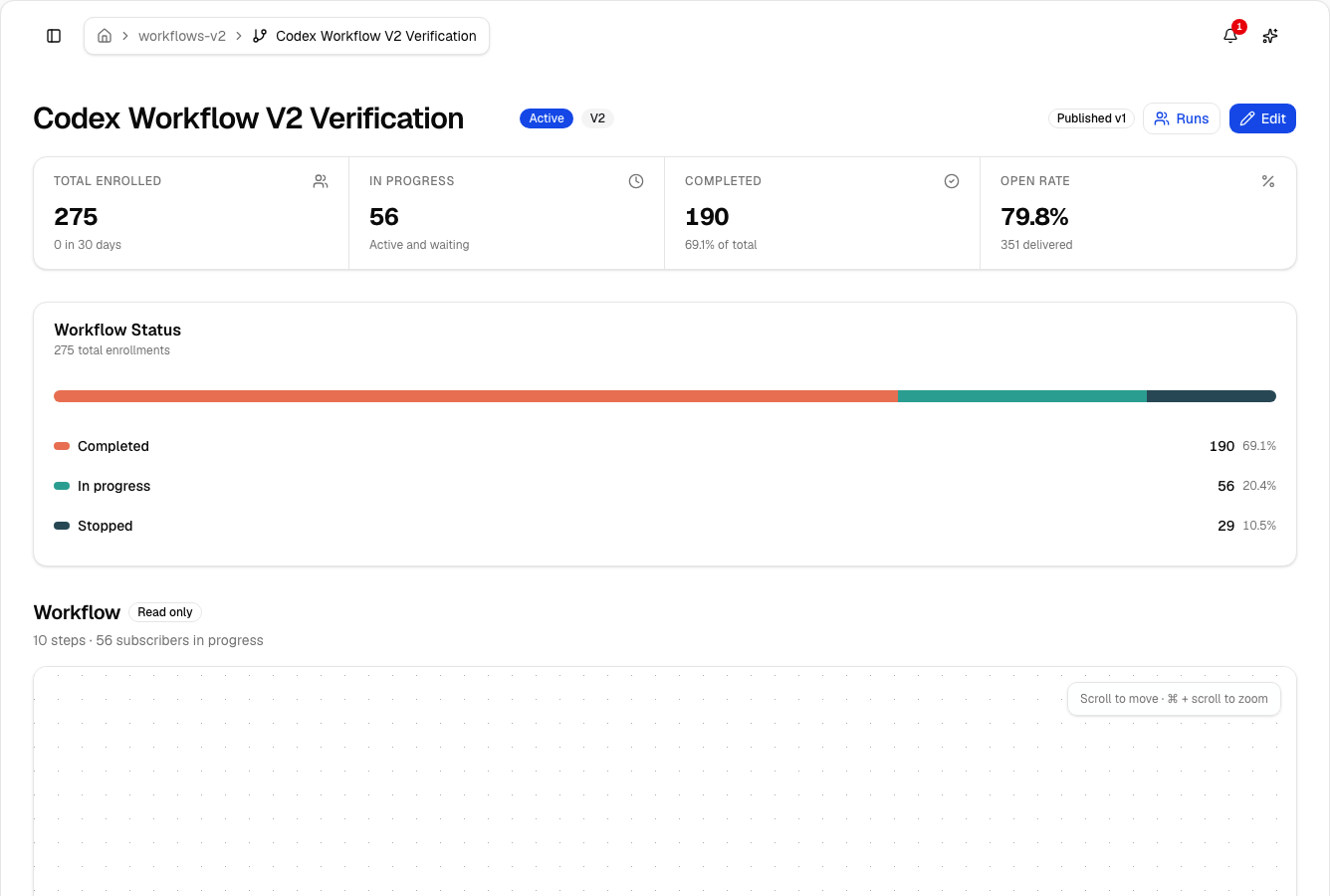
Lumail sends transactional email through a REST API or the SMTP relay at smtp.lumail.io:587 with STARTTLS, and it keeps campaigns, subscribers, capture pages, and graph-based workflows in the same organization. That covers the work Postmark tells you to keep in your application: the welcome sequence, the onboarding drip, and the product newsletter. Agents can run it through 89 organization-scoped MCP tools in ChatGPT, Claude, Claude Code, Cursor, and Codex, or through the CLI and TypeScript SDK.
Pricing: Free is 3,000 emails a month, no credit card. Premium is $20 a month with 40,000 emails included, then $0.60 per 1,000. Business is $200 a month with 400,000 included, then $0.40 per 1,000.
Choose it if:
- You send up to 3,000 emails a month (Lumail is free) or roughly 15,000 to 40,000, where Lumail stays at $20 while Postmark adds overage
- You want newsletters and lifecycle sequences built visually instead of coded against a Broadcast stream
- You want one suppression list across receipts and marketing
Watch out for:
- Lumail does not offer inbound email parsing or dedicated IPs. Postmark's Pro and Platform plans do.
- If separated transactional and broadcast IP infrastructure is your top requirement, Postmark's Message Streams are purpose-built for it.
See Lumail vs Postmark side by side, or the SMTP docs for the relay settings.
2. Resend: best for developer-first transactional email
Resend is the closest in spirit to Postmark: a developer email platform with a clean API, SDKs, SMTP, webhooks, inbound email, and deliverability tooling, with strong ties to React Email. It has added broadcasts, contacts, and automations on top.
Pricing: Free is 3,000 transactional emails or 1,000 marketing contacts. Paid is $20 a month for transactional and $40 a month for marketing.
Choose it if:
- You like Postmark's developer focus but want a 3,000-email free tier
- Your email templates are built with React Email
- You want SMTP, webhooks, and inbound email on one developer platform
Watch out for:
- Transactional and marketing are separate plans, so app email plus a newsletter means two subscriptions.
See the full Lumail vs Resend comparison.
3. Mailgun: best for API depth and inbound routes
Mailgun is Sinch's email API and SMTP relay, with inbound routes that parse incoming mail to JSON, email validation, US and EU regions, and batch sends of up to 1,000 personalized messages per API call. Each sending domain has its own queue and reputation.
Pricing: Free Send is 100 emails a day. Basic is $15 for 10,000 emails, then from $1.80 per 1,000. Foundation is $35 for 50,000; Scale is $90 for 100,000.
Choose it if:
- You need inbound routing without a separate plan upgrade for it
- You want EU data residency
- You send batch notifications at high volume
Watch out for:
- Inbox-placement testing and previews are separate paid products (Optimize and Inspect).
- Like Postmark, there is no journey builder.
See the full Lumail vs Mailgun comparison.
4. SparkPost: best for deliverability analytics at high volume
SparkPost, now part of Bird as Bird Email, is sending infrastructure with REST and SMTP, Signals predictive analytics, health scores, and spam-trap monitoring on its entry plan. If you picked Postmark for deliverability visibility, SparkPost goes deeper on analytics.
Pricing: Starter is $20 a month at the 50,000-email default. Premier is $75 a month at that volume and adds a dedicated IP, automated IP warmup, A/B testing, subaccounts, and inbound email webhooks.
Choose it if:
- You want deliverability analytics beyond delivery and bounce logs
- You need a dedicated IP well below Postmark's 300,000-email threshold (Premier)
- You manage several brands through subaccounts
Watch out for:
- Bird's newer platform pricing sits beside the SparkPost cards, so confirm which plan you are buying.
See the full Lumail vs SparkPost comparison.
5. MailerSend: best for visual templates at low volume
MailerSend is MailerLite's transactional product: REST API, SMTP relay, drag-and-drop and HTML template builders, inbound routing, and optional US and Canada SMS. It also ships a hosted MCP server and a CLI.
Pricing: Free is 500 emails a month after approval, with a card on file. Hobby is $7 for 5,000 emails, then $1.50 per 1,000. Starter is $35 for 50,000.
Choose it if:
- You send a few thousand emails a month and Postmark's $15 floor feels high
- Non-developers need to edit transactional templates
- You want optional US and Canada SMS from the same provider (Starter and up)
Watch out for:
- For newsletters and marketing automation, MailerSend points you to MailerLite, a separate product.
See the full Lumail vs MailerSend comparison.
6. Amazon SES: best for the lowest cost per email
Amazon SES is AWS's email API and SMTP interface. It is the cheapest option here by a wide margin, and it handles inbound mail through receipt rules or Mail Manager.
Pricing: À la carte outbound is $0.10 per 1,000 emails with no monthly minimum, plus data charges. Dedicated IPs are $24.95 per IP per month.
Choose it if:
- Cost matters more than tooling and your team already runs AWS
- You need inbound processing or archiving through Mail Manager
- You are comfortable building bounce handling and reporting on SNS or CloudWatch
Watch out for:
- New accounts start in a sandbox and must be approved for production sending.
- There is no campaign editor, audience, or workflow layer; everything above sending is yours to build.
See the full Lumail vs Amazon SES comparison.
7. Plunk: best open-source, pay-per-email option
Plunk is an AGPL-licensed email platform that combines transactional sending, campaigns, graph workflows, and inbound email. You can use the hosted service or self-host it, in which case sending runs through your own AWS SES account.
Pricing: Hosted Free is 1,000 emails a month with unlimited contacts and a Plunk footer on marketing emails. After that it is $0.001 per email with no base fee.
Choose it if:
- You send a few thousand emails a month and want to pay for exactly that
- You want to inspect or self-host the code
- You want transactional email and workflows in one open-source tool
Watch out for:
- There is no official MCP server or agent tool catalog.
- At high volume, pure pay-per-email costs more than plans with included buckets.
See the full Lumail vs Plunk comparison.
How to choose a Postmark alternative
- Deliverability evidence. Ask each vendor how transactional and bulk mail are separated, and send a week of real traffic before moving everything.
- Your volume band. Postmark is priced for 10,000 and up. Under that, Lumail's free tier, Plunk, or MailerSend Hobby cost less. Far above it, SES and committed-volume plans win.
- Marketing in or out. If newsletters and sequences already live in another tool, pick a pure API. If they live in your codebase, a platform that includes them removes code.
- Inbound and dedicated IPs. Check which plan unlocks each. Postmark requires Pro for inbound and 300,000 emails a month for a dedicated IP.
- Developer and agent access. Postmark ships a 24-tool local MCP server. Compare SDKs, SMTP, webhooks, and whether agents can operate the account, not just send.
Worked example: 25,000 emails a month. A SaaS sending 25,000 transactional emails a month would pay:
| Provider | Plan at 25,000 emails | Monthly cost |
|---|---|---|
| Amazon SES | À la carte | $2.50 plus data charges |
| Lumail | Premium, within 40,000 included | $20 |
| SparkPost | Starter, 50,000 tier | $20 |
| Plunk | 25,000 at $0.001 | $25 |
| Postmark | Platform, 15,000 over at $1.20 | $36 |
| MailerSend | Hobby, 20,000 over at $1.50 | $37 |
| Postmark | Basic, 15,000 over at $1.80 | $42 |
| Mailgun | Basic, 15,000 over from $1.80 | $42 |
| Resend | Transactional plan | Check its pricing page for your tier |
Postmark's own support documentation uses the same example: 25,000 emails on Basic is $42.
How to migrate from Postmark
- Export suppressions. Download bounces, spam complaints, and unsubscribes from Postmark and import them into the new provider before any send.
- Authenticate your domain. Add SPF, DKIM, and DMARC for the new provider while Postmark keeps sending.
- Swap one template. Move a single low-risk email, such as a login link, to the new API or to
smtp.lumail.io:587, and compare delivery events for a few days. - Rebuild broadcast logic as a workflow. If your app sends onboarding or product updates through a Broadcast stream, rebuild one of them as a workflow and test it on an internal segment.
- Cut over the rest. Move the remaining templates, keep Postmark on its lowest plan until bounces settle, then close it.
Frequently asked questions
What is the best free Postmark alternative?
Lumail's free plan is 3,000 emails a month with no credit card, and Resend's is 3,000 transactional emails. Both are 30 times Postmark's 100-email free tier.
Is there a cheaper alternative to Postmark?
Yes. Amazon SES costs $0.10 per 1,000 emails if you can run AWS. Among managed services, Lumail Premium includes 40,000 emails for $20, compared with $36 to $42 on Postmark at 25,000 emails.
What is the best Postmark alternative for transactional email?
Resend is the closest developer-first alternative, SparkPost goes deeper on deliverability analytics, and Mailgun adds inbound routes and EU hosting. Pick Lumail if the same account should also send your newsletters and sequences.
Can Postmark send newsletters?
Postmark can send broadcast email from your application through a separate stream, subject to approval, but it has no list uploads, visual editor, or campaign reporting. Lumail, Resend's marketing plan, and Plunk include campaign tools.
Who are Postmark's main competitors?
Postmark's main competitors are other transactional email services: SendGrid, Mailgun, Amazon SES, SparkPost, Resend, and MailerSend. Platforms like Lumail compete when teams want transactional and marketing email together.
Keep the deliverability, drop the second tool
If Postmark is doing its job and you only send app email, stay or pick the API that fits your volume band. If you also run newsletters and onboarding from code, start Lumail free and move one template and one sequence to compare. Every head-to-head table lives in the comparison hub.